
Add Row
Add Element
Kozi checks and balances
update

Kozi Checks & Balances
Media Site Home

cropper
update
Add Element
  • Categories
    • Kansas Tax Compliance
    • Audit-Proofing Strategies
    • Bookkeeping Basics
    • QuickBooks Optimization
    • Industry Insights
    • Tax Deduction Deep-Dives
    • Local Business Spotlights
    • Payroll Taxes
    • Business Directory
Add Row
Add Element
cropper
update
 Kozi Checks & Balances TaxTactics News 
cropper
update
July 22.2025
2 Minutes Read

Sales Tax Holidays: Are They Truly Beneficial for Consumers in 2025?

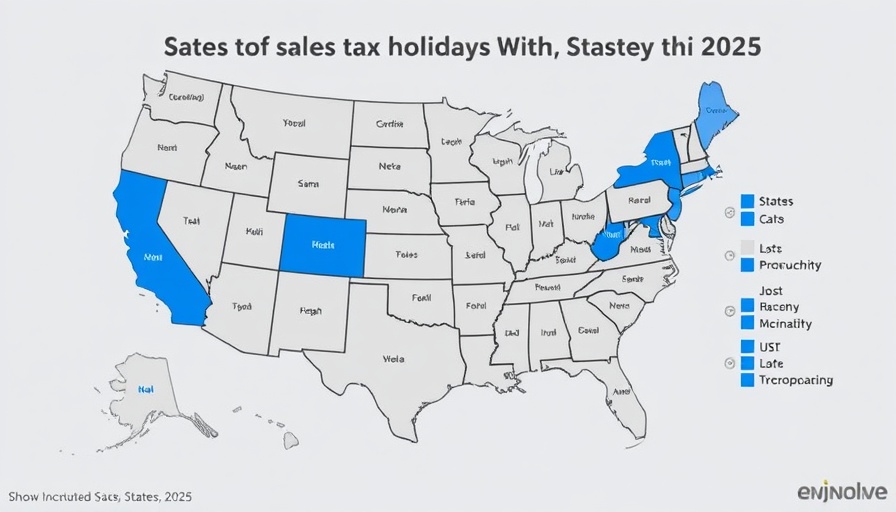
Map showing states with Sales Tax Holidays 2025 highlighted.

Understanding Sales Tax Holidays: Pros and Cons

Sales tax holidays in the United States are becoming a staple in state tax policies, set against the backdrop of rising consumer interest in immediate savings. In 2025, nineteen states have either enacted or will enact these holidays, allowing specific goods to be purchased without the burden of sales tax. While this might seem like a boon for buyers, it brings with it a plethora of economic implications and discussions about the effectiveness of such initiatives.

What Are Sales Tax Holidays and Why Do They Matter?

Sales tax holidays are designated periods when certain goods and services are exempted from state taxes. Common offerings include back-to-school supplies and seasonal items like hurricane prep kits. The popularity of these holidays is undeniable; they offer consumers the illusion of significant savings while generating buzz for local retailers. However, research shows that the majority of purchases made during these periods are simply shifted from other times of the year, resulting in no real economic growth. This displacement of consumer spending raises questions about whether the holidays truly benefit local economies.

Economic Effects: Are Consumers Truly Benefiting?

Despite the initial attractiveness of sales tax holidays, numerous studies point to a concerning trend: they merely shift consumer activity rather than stimulate additional spending. Consumers often plan their purchases around these holidays to benefit from tax savings, meaning state revenues suffer without tangible economic growth. This counterproductive effect illustrates the structural challenges within state tax codes, indicating a broader discussion about tax policy reforms is needed.

Potential for Policy Reform: Looking Ahead

The continuation of sales tax holidays might be a signal of an outdated tax system. If authorities are confident that suspending the sales tax temporarily could spur economic growth, it raises the fundamental question of whether the sales tax itself is too burdensome. Rather than temporary fixes, a thorough evaluation and reform of state taxation could provide more sustainable economic relief.

The Takeaway: Should You Plan Your Purchases Around Sales Tax Holidays?

For consumers pondering their shopping strategies for 2025, it’s crucial to plan wisely during these sales tax holidays. Despite the allure of saving a few dollars on purchases, it’s essential to recognize that these holidays might not provide as much economic uplift as advertised. Understanding the nature of consumer behavior during these periods allows for more informed purchasing decisions.

Tax Deduction Deep-Dives

0 Comments

Write A Comment

*
*
Related Posts All Posts
02.10.2026

Exploring Tax Trends: Personal Income Tax Rates in Europe for 2026

Update The Changing Landscape of Personal Income Tax in Europe As we step into 2026, the personal income tax landscape in Europe exhibit significant variations across its diverse economies. The taxation system in most countries operates on a progressive structure, meaning individuals pay higher tax rates as their earnings increase. This approach is designed to ensure fair contributions to government revenues, adapting marginal tax rates to reflect the economic capability of individuals. Key Statistics for 2026 According to recent data, Denmark now holds the highest top statutory personal income tax rate in Europe at 60.5%, followed closely by France at 55.4% and Austria at 55%. On the other end of the spectrum, Hungary imposes the lowest rate at 15%, alongside the Czech Republic and Estonia at 23% and 24%, respectively. Interestingly, outside the OECD, countries such as Bulgaria and Romania are also notable for their low rates at 10%. The Impact of Tax Brackets Understanding tax brackets is crucial, as they define how different portions of income are taxed. For example, in a country where the top income tax rate kicks in at €1 million, every euro earned beyond that threshold sees the highest rate applied. This structure aims to minimize any negative impact on individuals' willingness to earn more, although the overall design of these brackets directly influences taxpayer behavior across different income levels. Trends and Predictions in European Taxation Several countries are currently in the process of adjusting their tax rates. For instance, Denmark's creation of an additional tax bracket for high-income earners will further exacerbate its position as having the highest tax rate in Europe. Conversely, Finland has opted to decrease its top rate from 51.5% to 45%, potentially spurring increased economic activity among its citizens. These movements signal a broader trend in which countries are re-evaluating tax strategies to balance revenue needs with fiscal incentives. Conclusion: Insights for Local and Global Citizens Understanding the implications of these tax rates is essential, especially for expatriates, international employers, and local business owners alike. With looming changes in 2026, staying informed of these shifts allows stakeholders to make better strategic financial decisions. As government revenue structures evolve, so do the incentives and barriers for economic engagement among citizens. Whether you're an aspiring entrepreneur or a seasoned financial strategist, awareness of tax policies is crucial in navigating today's fiscal landscape.

02.06.2026

Exploring The State Income Tax Divergence: Trends and Impacts

Update The Changing Landscape of State Income Tax Rates In recent years, the narrative surrounding state income taxes has undergone a significant transformation. Once characterized by a relatively uniform rate hovering around the 6 percent mark, states are now gravitating toward a dualistic system. Some states actively seek to lower tax rates to attract businesses and individuals, while others pursue higher taxes, particularly on high earners. This divergence raises critical questions about the future of state economies and taxpayer mobility. Understanding the Current Diversification in Tax Rates Data shows a marked decline in the number of states maintaining top income tax rates between 5 to 7 percent; from 21 states two decades ago, to merely 12 today. In sharp contrast, states with rates below 5 percent have surged from 15 to 26. Furthermore, the segment of states imposing double-digit tax rates has increased from one to six, indicating a broader shift in taxation approach across the nation. The Motivations Behind Tax Rate Changes The Tax Cuts and Jobs Act of 2017 played a pivotal role in influencing state tax policy, enabling reductions in tax rates for many states. However, a renewed push for increased taxation on high-income earners emerged in light of pandemic recovery and fiscal demands. The situation showcases two opposing trends—while some states like Texas and Florida are focusing on reducing tax burdens to attract new residents, others are aiming for higher rates, leading to potential economic consequences. Implications for Taxpayers and State Economies The implications of these diverging paths are noteworthy. High tax rates may deter businesses and individuals, prompting them to reconsider their residence. Mobility has fundamentally changed; taxpayers are increasingly willing to relocate for better economic opportunities, making high-tax jurisdictions vulnerable. The shift creates a bimodal distribution of tax rates, complicating the traditional benchmarks for evaluating state tax climates. Future Outlook: Which Direction Will States Take? As states grapple with balancing budgetary goals and competitiveness, the future is uncertain. The focus may either continue to split into high and low tax regimes, or states could seek middle ground solutions to retain and attract taxpayers. The very character of fiscal policy in the U.S. is evolving, and it will be fascinating to observe how state lawmakers navigate these treacherous waters.

02.03.2026

How Nonresident Income Tax Filing and Withholding Laws Impact You in 2026

Update Navigating Nonresident Income Tax Filing: A Nuanced Challenge As the tax season arrives, millions of Americans brace themselves for a task that, for many, is anything but straightforward: filing their income taxes. Among them, nonresident taxpayers face unique challenges when it comes to filing in multiple states. In fact, this year, taxpayers who need to file nonresident income tax returns will find that navigating the intricacies is more complex than ever. Understanding State-Specific Filing Thresholds Currently, 22 states enforce stringent nonresident filing thresholds, requiring individuals to file even if they work in the state for just a single day. On the other hand, 19 states provide certain relief, allowing nonresidents a moment of respite. These variations can significantly alter one’s filing obligations. For instance, states like Illinois, Louisiana, and North Dakota set their thresholds based on the number of days worked, ranging from 20 to 30 days, while others base it on income earned, complicating the filing landscape further. Recent Changes Impacting Nonresident Tax Compliance The most recent tax filing season has brought about notable adjustments. For instance, Alabama has implemented a new threshold of 30 days for nonresident tax filing, while Louisiana raised its threshold from 25 to 30 days and simplified prior requirements. These updates mark an attempt by states to lighten the burden on taxpayers, yet they also require individuals to remain vigilant and up-to-date. The Importance of Accurate Documentation One of the critical aspects highlighted in the 2026 tax landscape is the necessity for accuracy in documentation. As the IRS continues to enhance its verification processes and increase scrutiny on tax returns, documentation errors can quickly lead to complications or delays. Nonresidents especially need to ensure all necessary paperwork is meticulously organized, not only to comply with state laws but also to avoid pitfalls inherent in a complicated tax system. Future Trends: Beyond 2026 Filing Changes Tax year 2026 marks a critical transition period in the filing landscape with many rules set to expire under prior legislation. As taxpayers strive to understand the implications of these changes, including the potential reversion of tax brackets, the need for strategic planning has never been more apparent. For nonresidents, understanding which states may alter their required filing triggers in the coming years could be crucial for optimizing their tax positions. Conclusion: Preparing for Complex Filings As the complexities of tax law evolve, early preparation and education are paramount for nonresident taxpayers. The shifting landscape can often feel overwhelming, but staying informed on state-specific regulations, filing thresholds, and changes in IRS processes can provide the clarity needed to navigate the intricate web of nonresident taxation.

Terms of Service

Privacy Policy

Core Modal Title

Sorry, no results found

You Might Find These Articles Interesting

T
Please Check Your Email
We Will Be Following Up Shortly
*
*
*